TMS Therapy in Salt Lake City, Utah
Still struggling with depression after trying medication? NeuroStar® TMS is an FDA-cleared, non-invasive treatment with no medication side effects and no downtime. Our Salt Lake City clinic offers TMS alongside psychiatry, therapy, and our 5-Pillar Mindfulness Program.
- Free consultation by telehealth or in person, often within the same week
- We verify your insurance benefits and submit prior authorizations
- Convenient clinic at 370 E. South Temple in Salt Lake City
- Psychiatry, therapy, and TMS coordinated under one roof
Free · No obligation · Confidential · No referral needed to start the conversation

Where can I get TMS therapy in Salt Lake City?
Neurobehavioral Center for Growth (NBCG) offers NeuroStar TMS at our Salt Lake City clinic, 370 E. South Temple. TMS is an FDA-cleared treatment for adults with major depressive disorder who haven't found enough relief from antidepressants. Our team verifies your insurance benefits, submits any prior authorization before treatment begins, and tells you what to expect before your first session.
Depression is real, and it is treatable
Life in the Salt Lake Valley can be demanding: long commutes, busy schedules, and the pressure to keep going when you are not okay. If antidepressants have not given you your life back, you have more options than another prescription.
Meds haven't worked, or the side effects are too much
TMS works on the brain directly rather than through your bloodstream, so it does not cause the weight gain, fatigue, emotional blunting, or sexual side effects many people get from antidepressants.
Fits a busy schedule
Sessions run about 19–37 minutes. There is no sedation and no recovery time, so most patients drive themselves in and go straight back to work or home.
We handle the insurance side
Benefits, authorizations, and plan rules can feel like a second job. Our team does the legwork and tells you exactly what, if anything, you need from your insurer or doctor.
Eligibility and coverage depend on your specific plan. We verify your benefits for you at no cost.
What happens between your first call and your first session
Here is the path at our Salt Lake City clinic, from the first conversation to life after treatment.
Reach out your way
Call us or send the short form. A member of our team gets back to you, usually the same or next business day. Keep your insurance card nearby if you can, but you don't need it to begin.
Talk it through in a free consultation
Meet with us by video or at our South Temple clinic. Ask anything, and decide together whether TMS makes sense. We begin checking your insurance benefits at this visit so the cost picture is clear before you commit.
Intake review and authorization
A provider goes over your history, past medications, and any therapy you've had to confirm TMS is a good fit. That same documentation supports the prior authorization we send to your insurer before treatment starts.
Daily NeuroStar sessions
Most patients come in five days a week for four to six weeks. Many pair TMS with our 5-Pillar Mindfulness Program to build skills that last beyond treatment.
Care that continues
Check-ins, medication management, and therapy carry on with the same providers once your course wraps up. You aren't passed along to someone new.
Know where you stand before you start
Coverage differs by plan and can change. This is a general guide; we confirm the specifics for your situation.
Verification is free and does not obligate you to start treatment.
TMS may be worth a conversation if…
- You're an adult diagnosed with major depressive disorder (MDD)
- One or more antidepressants haven't given you enough relief
- Medication caused side effects you couldn't live with
- You're looking for a non-invasive option that doesn't involve medication
- You're living with OCD and want something to add to your current care
- You can't afford downtime: you'd drive yourself to and from each session
- You'd rather have a team take care of the insurance paperwork
TMS isn't right for everyone. People with certain metal implants in or near the head, for example, usually can't have it. Your provider will go over this with you.

Your TMS session, step by step
Treatment happens in the clinic while you're awake, with no sedation.
Calibrate to your brain
Your first visit includes a short test to find your motor threshold, which sets the strength of the magnetic pulses for you.
Relax while the coil works
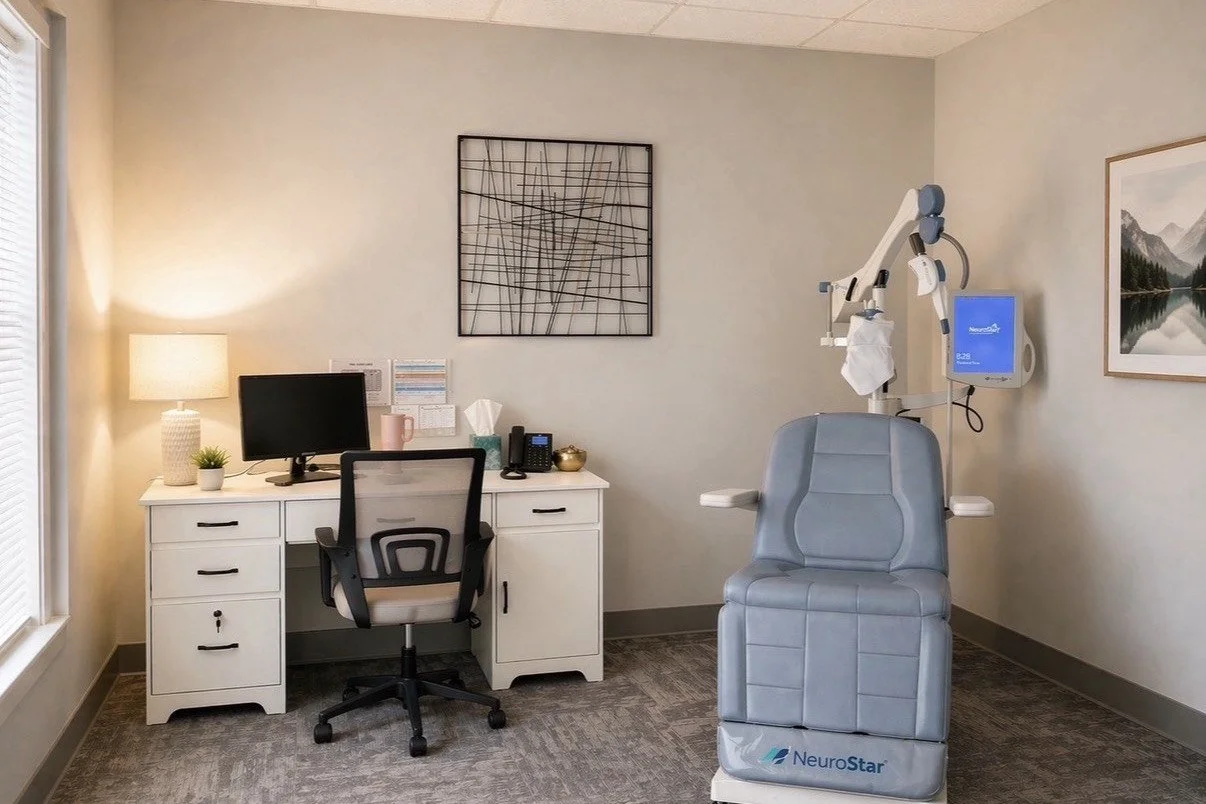
A small magnetic coil sits against your scalp. You stay awake and alert, and may feel a light tapping.
Head straight back to your day
A session lasts about 19–37 minutes. You can drive yourself home or return to work with no recovery period.
Improvement builds gradually
Mood changes often start showing up around weeks two to three, though everyone's experience is different.
See what a TMS session is like
A short tour of treatment at NBCG, from the first consultation through your sessions.
What the clinical research shows
NeuroStar is the most clinically studied TMS system available, with more than 5 million treatments delivered.
Honest answers about what TMS can and can't do
Depression often shows up alongside anxiety, sleep problems, or other health history. We'll be straightforward about what TMS is cleared to treat.
What TMS is cleared for
NeuroStar TMS is FDA-cleared for adults with major depressive disorder, including decreasing anxiety symptoms in patients with MDD, and as an adjunct for OCD.
When anxiety is part of the picture
Anxiety and depression often occur together. Your plan may combine TMS for depression with therapy and medication management from our team. Learn about anxiety care at NBCG →
Your medical history matters
Certain metal implants, a history of seizures, or head injury are things your provider will review before recommending TMS. We'll walk through your history together at intake.
How TMS compares
Not just a TMS machine. A full care team.
NBCG is the only practice in Northern Utah offering neuropsychological testing, ABA, speech therapy, psychiatry, TMS, Spravato®, and ketamine under one roof. For TMS patients, that means coordinated care from start to finish.
Integrated psychiatric care
TMS plus medication management and therapy from one coordinated team.
We handle insurance
Benefit verification, prior authorization, and cost transparency before you start.
Certified NeuroStar provider
Our team is trained on the most clinically studied TMS system available.
The 5-Pillar Mindfulness Program
TMS can help lift depression. Our structured mindfulness skills program runs alongside it to help you keep the progress.
1 · Foundations
Core awareness practices that interrupt unhelpful thought cycles.
2 · Awareness
Observe thoughts and emotions without being swept away.
3 · Connection
Rebuild relationships with yourself and the people around you.
4 · Insight
Understand your patterns, triggers, and strengths.
5 · Purpose
Reconnect with what matters most and build a life that protects your mental health.
Our Salt Lake City TMS clinic
Daily sessions need to be convenient. Our Salt Lake City clinic is on South Temple, with easy access from across the Salt Lake Valley. Telehealth consultations are available from anywhere in Utah.
Salt Lake City
370 E. South Temple St., Unit 175Salt Lake City, UT 84111
(385) 452-8566
Serving patients from Salt Lake City, Downtown, the Avenues, Capitol Hill, Sugar House, Millcreek, Holladay, Murray, South Salt Lake, and across the Wasatch Front.
NeuroStar TMS treatment is delivered at our Salt Lake City, South Ogden, and Bountiful clinics.
TMS in Salt Lake City: frequently asked questions
Where can I get TMS therapy in Salt Lake City?
NBCG offers NeuroStar TMS at our Salt Lake City clinic, 370 E. South Temple St., Unit 175. You can start with a free consultation by telehealth or in person, and sessions are delivered at the clinic.
Does insurance cover TMS?
Many insurance plans cover TMS for major depressive disorder when their criteria are met, which usually includes trying antidepressants first. Coverage rules are set by each plan and can change, so NBCG verifies your benefits and submits prior authorization before you begin.
Does NBCG accept TRICARE for TMS in Salt Lake City?
Yes. NBCG accepts TRICARE for NeuroStar TMS at our Salt Lake City clinic. We verify your plan, check current requirements, and submit the prior authorization for you.
Do I need a referral to start TMS?
Not to start the conversation. You can contact us directly for a free consultation. Some insurance plans require a referral for specialty care, and if yours does, we tell you exactly what to request and help coordinate it.
Who qualifies for TMS?
TMS is FDA-cleared for adults with major depressive disorder who haven't gotten enough relief from antidepressant medication, and as an adjunct for OCD. A provider reviews your history at intake, including any metal implants in or near the head, to confirm TMS is appropriate.
How much will TMS cost me?
Your out-of-pocket cost depends on your plan, deductible, and cost-share. We give you a cost estimate before you start treatment so there are no surprises.
How long does a TMS course take?
A typical course is five sessions a week for four to six weeks. Each session runs about 19–37 minutes, and many patients notice mood shifts around weeks two to three. Individual results vary.
Does TMS hurt, and what are the side effects?
TMS is done while you're awake. You may feel a light tapping sensation, and the most common side effect is discomfort at or near the treatment site, which is usually transient and doesn't continue for most patients after the first week. There is a rare risk of seizure (less than 0.1% per patient). Your provider will review safety information with you.
How is TMS different from ECT?
TMS is non-invasive and requires no anesthesia or sedation. You stay awake, there is no memory-loss risk, and you can drive yourself to and from treatment. ECT involves anesthesia and typically requires someone to take you home.
Can I do my first consultation by telehealth?
Yes. Your free consultation can be by telehealth or in person. TMS sessions themselves take place in person at the clinic.
In crisis or having thoughts of suicide?
You don't have to wait for an appointment. Call or text 988 to reach the Suicide & Crisis Lifeline, or call 911 in an emergency. Veterans and service members can press 1 after calling 988, or text 838255. Support is free, confidential, and available 24/7.
Ready to feel like yourself again?
Tell us a little about yourself and a member of our team will reach out, typically within one business day, to answer your questions and check your insurance benefits. No obligation, no pressure.
- Free, no-obligation consultation
- We verify your insurance coverage before you commit
- Telehealth or in-person
- Confidential: your information is private
Want to read more first? Visit our Education Center →
Request a call back
Share a few details and our team will reach out, typically within one business day.
Open the Inquiry Form Call (385) 452-8566Form not loading? Open the form in a new tab →